


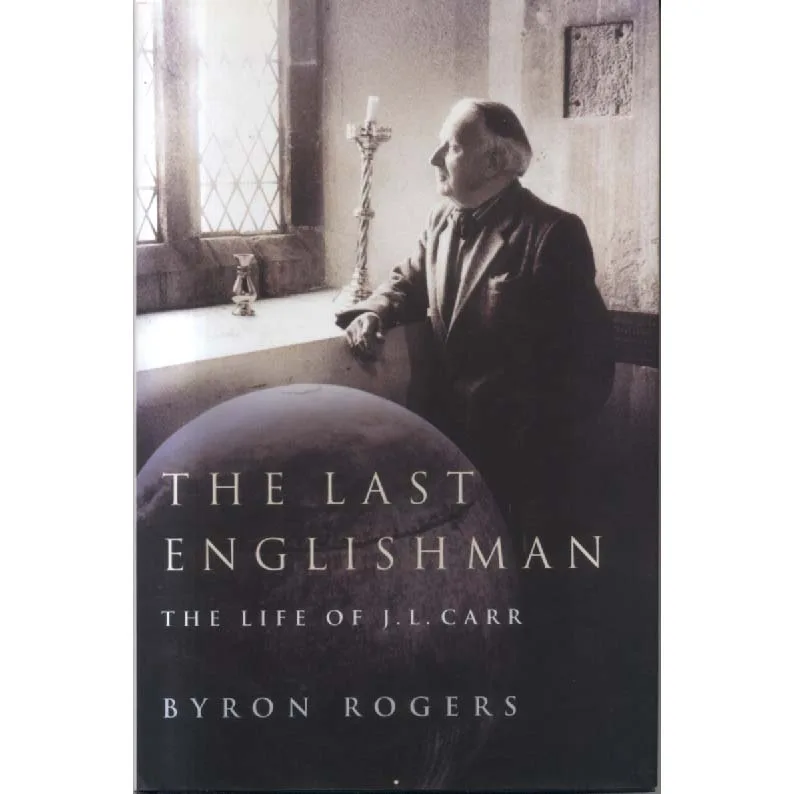
The Last Englishman - The Life Of JL Carr
Publisher: Aurum Press
Format: Hardback
ISBN: 9781854108388
The Last Englishman – The Life of J. L. Carr (2003) by Byron Rogers
Aurum Press | ISBN: 9781854108388 | Condition: Good
There are eccentric Englishmen, there are spectacularly eccentric Englishmen, and then there was J. L. Carr, a novelist, schoolmaster, publisher, mapmaker, cricket enthusiast and general-purpose national treasure who appears to have spent much of his life demonstrating that it was entirely possible to be gloriously unconventional without making the slightest effort to appear interesting. In The Last Englishman, Byron Rogers undertakes the rather wonderful task of chronicling the life of a man who seemed to have wandered out of an earlier century, taken one look at the modern world and decided that, on balance, he preferred doing things his own way.
James Lloyd Carr was not the sort of literary figure one could easily imagine presiding over fashionable London dinner parties, discussing the latest trends in postmodern fiction while sipping something expensive and pretending to understand contemporary art. He was altogether a more peculiar and infinitely more engaging creation: a former headmaster from Northamptonshire who wrote beautifully understated novels, published eccentric little books, produced miniature maps and maintained a magnificent disregard for the conventions of literary celebrity.
His best-known novel, A Month in the Country, became a much-loved classic of English fiction, a delicate, melancholy and quietly humorous account of memory, restoration and the lingering consequences of the First World War. It was subsequently adapted into a film starring Colin Firth and Kenneth Branagh, thereby introducing Carr’s work to an audience considerably larger than the number of people who might ordinarily seek out a novel by a retired provincial schoolmaster.
But there was considerably more to Carr than one celebrated novel, and Byron Rogers is just the biographer to uncover it. With an eye for absurdity, affection for individualism and a healthy appreciation of the ridiculous, Rogers explores the extraordinary life of a man whose apparent ordinariness concealed a wonderfully independent imagination. Carr’s world was populated by schoolchildren, cricketers, eccentric acquaintances, literary characters and the sort of determinedly English personalities who would consider discussing their emotions in public an unfortunate lapse in good manners.
Carr’s publishing activities were particularly remarkable. Having established the Quince Tree Press, he produced an assortment of small books, maps and literary curiosities that reflected his particular interests rather than any conventional understanding of commercial opportunity. In an age when publishing was becoming increasingly dominated by large organisations, marketing departments and carefully calculated profit margins, Carr demonstrated the admirable possibility of running a publishing enterprise largely because one fancied publishing things.
This was, of course, a hopelessly unreasonable approach to business, since it placed personal enthusiasm above the demands of market research, corporate strategy and the opinions of people who use the word ’synergy’ without embarrassment. Naturally, it also produced work of considerable individuality and charm, which perhaps explains why the method has never become particularly fashionable in executive boardrooms.
The title The Last Englishman is itself a deliciously provocative proposition. England has produced a seemingly inexhaustible supply of eccentrics, misfits, amateur scholars, obsessive collectors, determined gardeners and gentlemen who devote forty years to researching the history of an obscure railway junction. Declaring any one of them the last of the species is surely premature. Nevertheless, Carr represents something increasingly rare: a man whose identity was shaped by local loyalties, intellectual curiosity, stubborn independence and a complete absence of interest in being fashionable.
Rogers captures this vanished, or at least rapidly vanishing, England with warmth and an appropriately mischievous sense of humour. It is a country of village schools, cricket pitches, small printing establishments, eccentric local characters and people who pursue strange private enthusiasms without feeling obliged to explain themselves to the rest of humanity. One suspects that Carr would have been profoundly unimpressed by the modern expectation that every hobby should become a profitable business, every opinion should be broadcast internationally and every modest personal achievement should receive an announcement on social media.
There is also the fascinating contrast between Carr’s outwardly conventional life and his extraordinary literary imagination. A schoolmaster and administrator might seem an unlikely candidate for enduring literary distinction, particularly one operating at some distance from the fashionable centres of British cultural life. Yet Carr produced fiction of remarkable tenderness, originality and emotional intelligence, suggesting that the human condition can be studied just as profitably in Northamptonshire as in Bloomsbury, and possibly with rather fewer pretentious conversations.
The biography is not simply a celebration of charming eccentricity, however. Carr was a complex individual, and the circumstances of his life, his ambitions, his relationships and his sometimes contradictory attitudes provide Rogers with material far richer than the familiar portrait of a harmless English oddball. Great individuality frequently comes with awkward edges, and it is precisely these inconsistencies that make a life worth examining rather than merely commemorating.
For admirers of A Month in the Country, The Harpole Report, How Steeple Sinderby Wanderers Won the F.A. Cup and Carr’s other remarkable novels, this biography offers an opportunity to encounter the man behind the writing. His experiences in education, his fascination with cricket, his ventures into publishing and his distinctive understanding of English life all contributed to the unusual literary voice that continues to attract appreciative readers.
There is something particularly appealing about a writer who achieved lasting recognition without appearing to organise his entire existence around the pursuit of fame. In today’s literary marketplace, where authors may be expected to maintain websites, cultivate audiences, attend festivals, participate in promotional campaigns and explain their personal brand, Carr’s example seems almost revolutionary. He wrote books, published things that interested him and carried on being himself, an approach so straightforward that it would probably give a modern publicity consultant a nervous breakdown.
Byron Rogers makes an excellent companion for this journey. His biographical writing combines careful observation with a gift for noticing the comic absurdities of human behaviour, and Carr’s unconventional existence provides abundant opportunities for both. The result is a portrait of an intriguing literary figure and a broader reflection upon English character, provincial life and the wonderfully unpredictable ways in which creative talent can emerge.
This 2003 Aurum Press edition is offered in Good condition by Crappy Old Books, a bookseller that naturally feels a certain sympathy with anyone who establishes a small publishing enterprise, develops peculiar specialist interests and then carries on regardless of whether the wider commercial world considers the operation entirely sensible.
Indeed, the story of J. L. Carr ought to provide considerable encouragement to anyone who has ever been informed that their interests are too obscure, their methods too old-fashioned or their ambitions insufficiently profitable. Apparently, it is quite possible to spend a lifetime following one’s own peculiar course and still leave behind something of genuine cultural importance. This must be a deeply troubling thought for those who believe success can only be achieved through business plans, market positioning and motivational seminars.
An excellent addition to any collection of literary biography, English social history or books about splendidly unconventional individuals, The Last Englishman will particularly appeal to admirers of Carr’s fiction, enthusiasts of small-press publishing and readers who appreciate the quieter, stranger and more stubbornly independent corners of British cultural life.
It is also a highly suitable book for anyone who has ever felt slightly out of step with the modern world, not necessarily because the world has gone wrong, but because one occasionally suspects that previous generations were allowed to be eccentric without having to complete an online registration form.
A wonderfully engaging portrait of a singular English writer, a celebration of literary independence and a reminder that some of the most interesting people in history were those who never thought it necessary to behave like everybody else.
And if J. L. Carr really was the last Englishman, one can only hope that somebody remembered to tell the others. Otherwise there may still be several hundred of them wandering around Northamptonshire, publishing miniature books, collecting obscure maps and refusing to acknowledge that the twentieth century has ended.
Keep browsing: See more Biography books Other books by Byron Rogers
